The Lab.
Not a magical box that replaces an electronics engineer. A practical way to let a computer see the same board through several instruments at once.
The first rule is deliberately unglamorous: keep the instruments that already work. Add the missing pieces for safe control, shared timing, board context, fixtures and repeatable evidence.
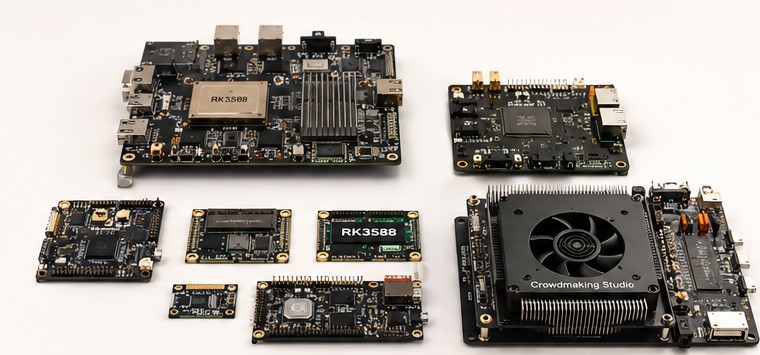 Proposed hardware
Industrial-design study, not a shipping product photograph.
Imagine that a board suddenly restarts after ten minutes of hard work.
An engineer might watch the power on an oscilloscope, read text scrolling past in a serial window, put a finger near a warm regulator, then point a thermal camera at the board. The clues are there. The difficult part is joining them into one event and then choosing the next test without changing five things at once.
The Lab is meant to turn that messy bench episode into something repeatable: same board, same fixture, same software, same test, same limits, synchronized measurements, preserved raw evidence.
Build only the parts the experiment needs.
Bench controller
The quiet coordinator. It discovers connected instruments, starts tests, timestamps events, records the evidence and keeps the hard safety rules local even if the higher-level software crashes.
It should speak ordinary instrument protocols and open APIs. It should not force people to replace a perfectly good scope just because we want a branded box.
Repeatable board holder
A board-specific plate with known contacts, connectors and physical reference points. The boring mechanical part that makes “run it again” actually mean the same thing.
Instead of hand-placing probes after every revision, important signals, power, reset, debug and communication lines can be reached in known positions.
Thermal + visible cameras
One camera sees the board as people see it. Another sees temperatures as measurements. Their view is registered to the board so a hotspot can be associated with a real component rather than “the red blob near the corner.”
We should begin by integrating existing radiometric cameras. Building a thermal camera from scratch is not the valuable problem.
Controlled power & load
The board can be switched on, stressed, reset and measured inside limits agreed before the run.
Current, voltage and temperature ceilings belong in local executable rules. A language model should never be able to talk its way around them.
Your existing instruments
Scopes, logic analysers, power supplies, loads and signal generators remain measurement authorities. The Lab connects them to the same experiment record.
The adapter layer translates capabilities without hiding the original data, instrument identity, settings or calibration information.
Software meets the board
Boot logs, firmware flashing, reset lines, JTAG/SWD, CAN, UART and other interfaces let a physical test include the software state that created it.
A hardware revision and the software needed to boot it should travel through the project together.
A common clock for a messy bench.
Different instruments live on different clocks. A thermal camera may capture tens of frames per second. A scope may sample millions or billions of times per second. A USB log arrives when the operating system gets around to delivering it.
If the website draws all of those traces on one perfect timeline, it must not pretend they were measured with precision they do not have.
Some experiments can share a hardware trigger. Others can use a local event box that timestamps stimulus and capture edges. Slow logs may only be aligned to a window of uncertainty.
Being explicit about that uncertainty is part of the product.
A useful result is not “everything happened at 08:43.217.” It may be: “the power event definitely came first; the software log followed within this measured window; the thermal change was slower.”
Bench. Node. Commons.
Bench
For one engineer. Adds board context, evidence capture and adapters to equipment already on the desk.
Node
For repeatable unattended or supervised testing. Adds dedicated power control, cameras, a fixture and local safety logic.
Commons
For a hackerspace or shared lab. Publishes what the lab can measure and lets open projects request repeatable experiments.