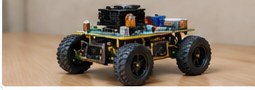
Robotics teams
The robot works. Now five boards, adapters and cables have to become one reliable system.
Crowdfunding helped people finance ideas. We want to make the next part collective too: designing, testing, fixing and eventually building the thing itself.
Crowdmaking brings together people who know different parts of the job, shared workshops with real instruments, open designs, and software that can keep track of thousands of tests without losing the thread.
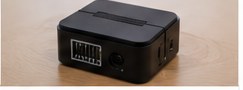
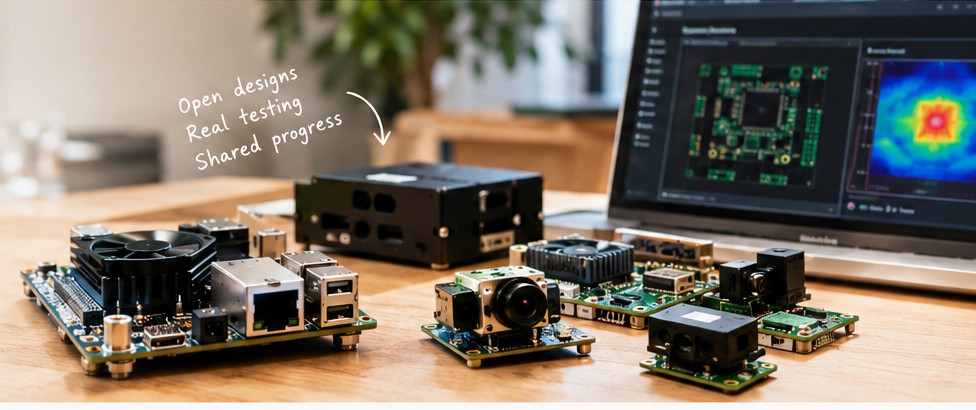 Concept image
Visual direction only. The equipment shown is not a photograph of a finished Crowdmaking product.
A prototype can work beautifully on a table and still be a long way from becoming a dependable object that another person can use.
The first version may be a handful of development boards connected by cables. Then somebody has to make the power reliable, combine the boards, deal with heat, make the software start every time, find parts that can actually be bought, design a case, test it, and discover what happens when reality behaves differently from the drawing.
That work is slow partly because every specialist sees only a slice of it. The person looking at the oscilloscope has one story. The software log has another. The thermal camera has another. The board designer remembers what changed three revisions ago. A useful result may live in somebody's notebook and never make it back into the project.
Crowdmaking is our attempt to make that whole process visible, shareable and cumulative.
The scarce thing is no longer ideas. It is contact with reality.
Software can compare many layouts, components, cooling ideas and system arrangements cheaply. Most bad ideas should die there.
A physical prototype is expensive information. We want power, heat, signals, logs and visible behaviour recorded together rather than as separate anecdotes.
Every useful observation keeps its connection to the exact board, design, test, person, lab and change that produced it.
There are already excellent computer-controlled oscilloscopes, logic analysers, programmable power supplies and thermal cameras. We do not need to replace them all.
What is missing is a common layer that knows what those instruments are looking at. If a board resets, the system should be able to line up the brief dip in a power rail, the message in the boot log, the loss of a network link and the hot component seen by a thermal camera.
Then, instead of producing a page of guesses, it should propose one useful next test: measure this point, change this one condition, keep these safety limits, and see which explanation survives.
Walk through an example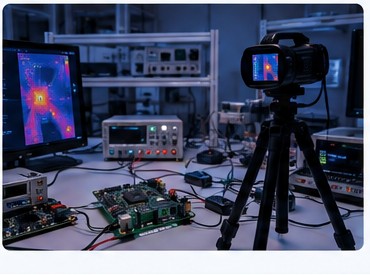
A project can need a thermal camera for one afternoon, a person who understands a power circuit, a fixture machined in another city, a software fix, and a second lab willing to repeat a suspicious test.
Today those needs are mostly coordinated by companies, private networks, or improvised forum posts. We want a project to be able to publish the exact thing it needs, discover a person or workshop able to do it, send a repeatable test, and bring the result back with its history intact.
That does not mean anonymous crowds voting on engineering truth. Contributions earn attribution. Evidence earns confidence. A result becomes stronger when somebody else can reproduce it.
Open source became powerful because code could accumulate. Crowdmaking asks what it would take for physical engineering knowledge to accumulate in the same way.
The robot works. Now five boards, adapters and cables have to become one reliable system.
A Jetson, RK3588 or Compute Module proves the idea; a carrier, software image and test process make it repeatable.
Teams that cannot keep a power engineer, Linux specialist, test engineer and manufacturing expert on staff at once.
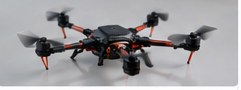
Places with instruments and practical skill that could become nodes in a distributed open research workshop.