The Commons.
Crowdfunding gathered money around an idea. Crowdmaking tries to gather the ability to make it real.
A difficult hardware project needs more than capital: people who know different things, places with tools, patient tests, manufacturing experience, failed boards, software work and someone willing to check the result again.
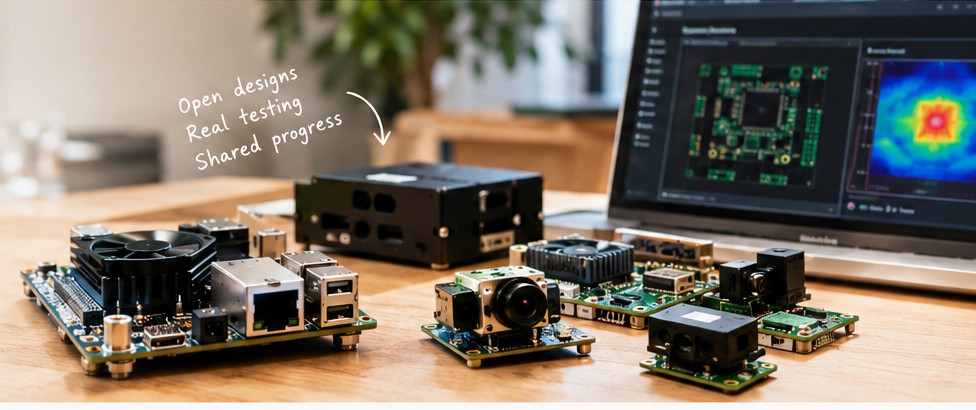 Commons concept
The crowd does not vote a circuit into working. It contributes work that can be checked.
A contribution might be a better schematic. It might also be a thermal run, a fixture, a failed reproduction, a sourcing discovery, a bootloader patch or ten minutes with an instrument another person does not own.
Each useful contribution should retain a simple chain: who or what proposed it; which exact artifact it concerned; what was done; which tools or lab were used; what evidence came back; and whether that evidence changed the project.
This is why provenance matters. Not as bureaucracy, but as memory.
People should be visible. Evidence should still win.
Open collaboration often loses valuable labour in a fog of usernames, chat messages and uncredited fixes. Crowdmaking should make attribution easy enough that a person who saved a board revision, built a fixture, ran a difficult test or reproduced a failure remains attached to that contribution.
That can support reputation, authorship and, where a project chooses, financial reward.
But attribution is not the same thing as truth. A famous contributor can be wrong. A new contributor can find the decisive fault. An AI system can propose a useful experiment without becoming the scientific authority for the result.
The contribution graph remembers who did the work. The evidence graph decides what the work supports.
Labs become capabilities a project can ask for.
A hackerspace, university lab, company workshop or independent engineer could publish a machine-readable description of what is available: scope bandwidth, thermal camera, CAN tools, JTAG, programmable power, 3D printing, fixture types, and whether a human must supervise a run.
The project does not remotely seize that equipment. It discovers that a suitable lab exists and prepares a bounded test request. The local operator accepts it, performs or supervises it, and the evidence returns signed to the exact experiment and board.
That is how a distributed commons could acquire physical reach without owning one giant central laboratory.
Disagreement becomes a new experiment.
Amsterdam sees a regulator failure. Eindhoven repeats the test and sees it too. Berlin does not.
In an ordinary forum, that can turn into an argument. In Crowdmaking, the difference itself becomes structured evidence. Were the boards from different manufacturing batches? Was the ambient temperature different? Did one fixture add resistance? Was a component substituted? Was the firmware truly identical?
Distributed reproduction is not merely a way to confirm results. It is a way to discover hidden variables.
The commons does not have to become the factory of record.
A Crowdmaking project can develop an open, well-tested reference design through repeated research builds. A separate company can later decide to turn one exact revision into a commercial product, undertake the applicable conformity work, arrange production, provide support and take the corresponding commercial responsibilities.
Another company could make a rugged version. A third could turn it into a teaching kit. The shared design and public evidence can continue to improve independently.
The commons creates reusable engineering capital. Commercial actors can create supported products from particular frozen revisions.
The exact legal structure and EU product-law treatment require qualified advice for each real product. “Open” and “nonprofit” are not automatic exemptions from safety or conformity law.
Bring a question, a skill, a tool or a place to test.
Build with us
Board design, firmware, fixtures, instrument adapters, thermal registration, testing, documentation and the boring glue that makes repeatability possible.
Become a lab node
Help define the minimum capability manifest and run one canonical test in a second physical location.
Bring a real prototype
The best early projects will have a working dev-board system and one painful physical question that can be measured rather than debated.
The first commons milestone is deliberately small: two places, one shared experiment, one result that can be compared.
A steward, a community, and commercial work where it belongs.
One possible Dutch structure is a foundation that keeps the long-lived mission, archives, open designs and infrastructure; a member association if democratic contributor governance needs its own home; and a separate cooperative or company for paid engineering and commercial products.
We do not need to create all of those entities on day one. The principle is more important than the boxes: no single product should have to own the commons in order for the commons to survive.